
Verify Orange County Voter Registration
The Orange County Voter Lookup is meant for a voter to verify his or her own record. It is not an open search by another person's name. Start with the date of birth. Then supply the last four digits of a California driver license or ID. A voter without one uses the last four digits of a Social Security number instead. The tool can ask for the first three letters of the first name when it needs one more check.
| Lookup prompt | Entry type | When needed | How it is used |
|---|---|---|---|
| Date of Birth | Date | Required | Matches the voter's own record |
| Last four digits of CA driver license or ID | Number | Conditional | Used when the voter has a California license or ID |
| Last four digits of SSN | Number | Conditional | Used when the voter has no California license or ID |
| First 3 letters of first name | Text | Conditional | Provides more verification when requested |
The county's secure voter lookup screen shows how Orange County asks for those verification fields.
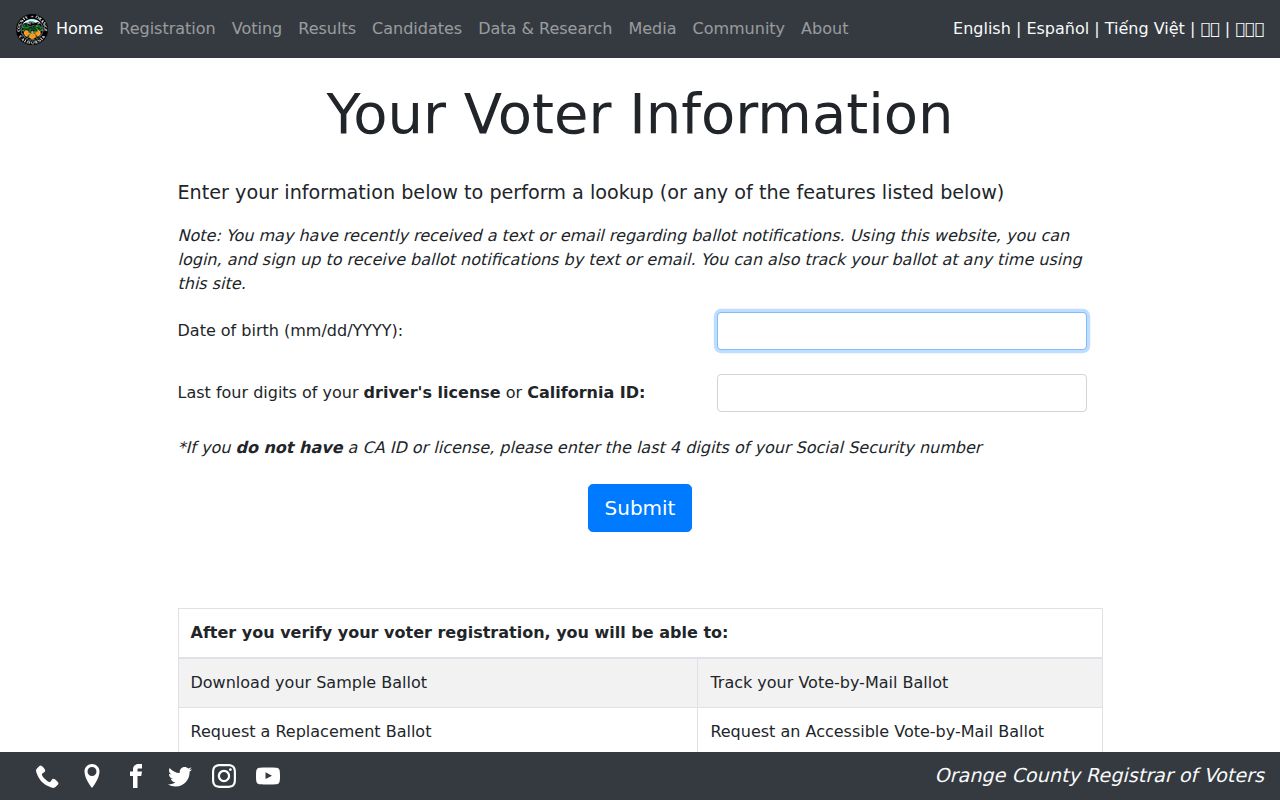
Those identity checks separate a personal status lookup from a request for a restricted voter file. Note: A failed match is a reason to contact the Registrar, not proof that a registration does not exist.
Orange County Voter Lookup Results
Once verified, an Orange County voter can confirm the address and voter registration status on file. The same tool links to a sample ballot and voter information guide. It also identifies political districts and elected officials tied to the registration. Those results help a voter spot an address issue before relying on the record.
The tool also supports election tasks. A voter may track a vote-by-mail ballot, ask for a replacement ballot, request an accessible vote-by-mail ballot, check a provisional ballot, opt out of a paper voter guide, and view voter history. Tracking may show when a ballot was issued and returned, the return method and location, and its status. Email or text updates are available for tracking. None of these functions turns the system into a search for the public at large.
Orange County Voter Record Inventory
An authorized voter data file is broader than the self-check result. The Orange County included-data description and the Secretary of State inventory distinguish registration facts from optional participation data. Active voter data comes with a standard file. Inactive voters must be requested. Availability also depends on the protected-voter rules.
| Voter name | Included in the restricted voter registration data file |
|---|---|
| Date of birth | Included in the file layout for an authorized recipient |
| Registration date | Shows when the voter registered |
| Residence and mailing addresses | Included unless confidentiality protection applies |
| Precinct and party preference | Included registration fields |
| Contact information | Included when present |
| Participation history | Optional election date, type, and voting method, never ballot choices |
A political districts file can map precincts to districts. It is a different product from a person's ballot or vote selections. The voter record reflects administrative facts about registration and participation, not how the person voted.
Orange County Voter Data Eligibility
California does not treat voter registration data as an ordinary public record. Authorized access can serve an election, candidate, political, scholarly, journalistic, or governmental purpose. Candidates and committees supporting or opposing an initiative or referendum are among the listed users. The applicant must describe the intended use and identify the person or group that will benefit from it.
Orange County's application asks for identity, contact, residence, mailing or business address, the beneficiary organization and address, intended use, and security measures. It also calls for a signature under penalty of perjury. Supporting records may be needed to prove the stated purpose. A broad wish to find neighbors or build a mailing list does not fit the statutory access route.
Restricted-use data. Elections Code section 2194 permits defined civic, research, news, political, and government purposes. It bars personal, private, and commercial use.
Requesting Orange County Voter Files
The Registrar of Voters data request page provides the application, product list, fee information, and data format. County requests can be delivered in person or mailed to 1300 South Grand Avenue, Building C, Santa Ana, CA 92705. The process is document based, not a web download open to all.
- Choose the county product and complete every applicable field. Explain the permitted purpose and the steps that will keep the data secure.
- Sign the application with an original wet signature. Add supporting documents and, for a mail request, a copy of a driver license or other official photo ID.
- Submit payment before processing. Pick up approved data in person or arrange shipment for a fee; the published form also lists electronic delivery choices.
The county's published 2025 application listed a standard countywide file with all voting history at $37 and a customized file at $80. It listed a street index at $1.50 per 1,000 voters plus $0.06 per printed page, and specific voter record copies at $0.15 per page. Email delivery was free, while USB delivery added $3.49. Applicants should confirm the current product sheet before paying.
The official Orange County request page places the application and delivery rules together.
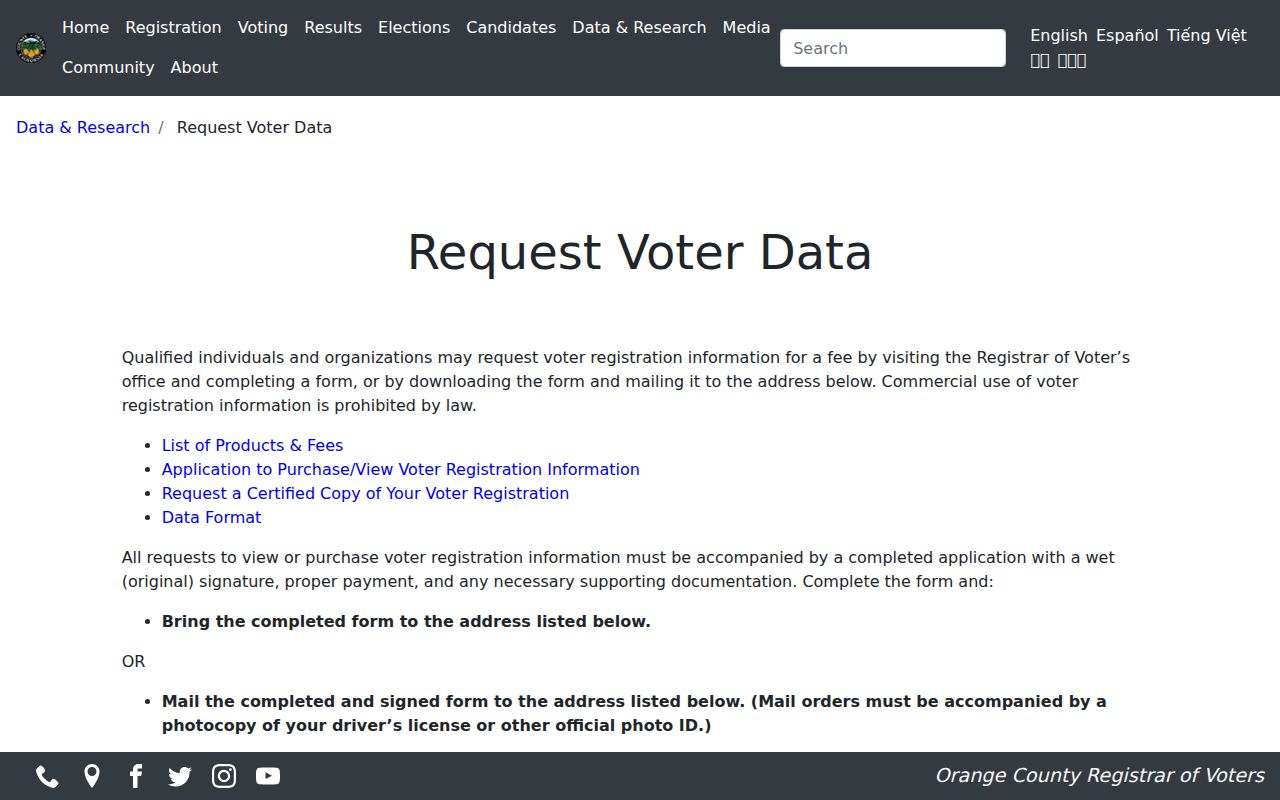
That source is the best checkpoint for a new form or fee list before a voter file order is sent.
Orange County and State Requests
A county order is the direct route when the needed voter records are confined to Orange County. The California Secretary of State also accepts statewide and specific-voter applications. Its voter information file request process applies the same permitted-purpose and security framework across California.
The statewide file costs $100, according to the state request page. A specific-voter order can cover up to ten voters and must give each person's full name, date of birth, county of residence, and residence address. The listed fee is $30 per record, capped at $100. State review is described as taking 7 to 14 business days. County file fees can differ, so the scope of the research should drive which office receives the request.
Note: Use the county route for an Orange County dataset and the state route when the needed scope crosses county lines.
Confidential Orange County Voter Records
Some fields never go to voter-file recipients. Elections Code section 2194 withholds driver license numbers, California ID numbers, Social Security numbers, unique voter identifiers, and signatures. Pre-registration records for 16- and 17-year-olds are not included. Voters protected under Elections Code sections 2166, 2166.5, 2166.7, or 2166.8 are excluded even when the requester otherwise qualifies.
Confidential by law. Government Code section 7924.000 and Elections Code section 2194 keep registration affidavits off routine public terminals and protect specified identifiers, signatures, and confidential voters.
The Registrar explains local protection on its confidential voter registration page.
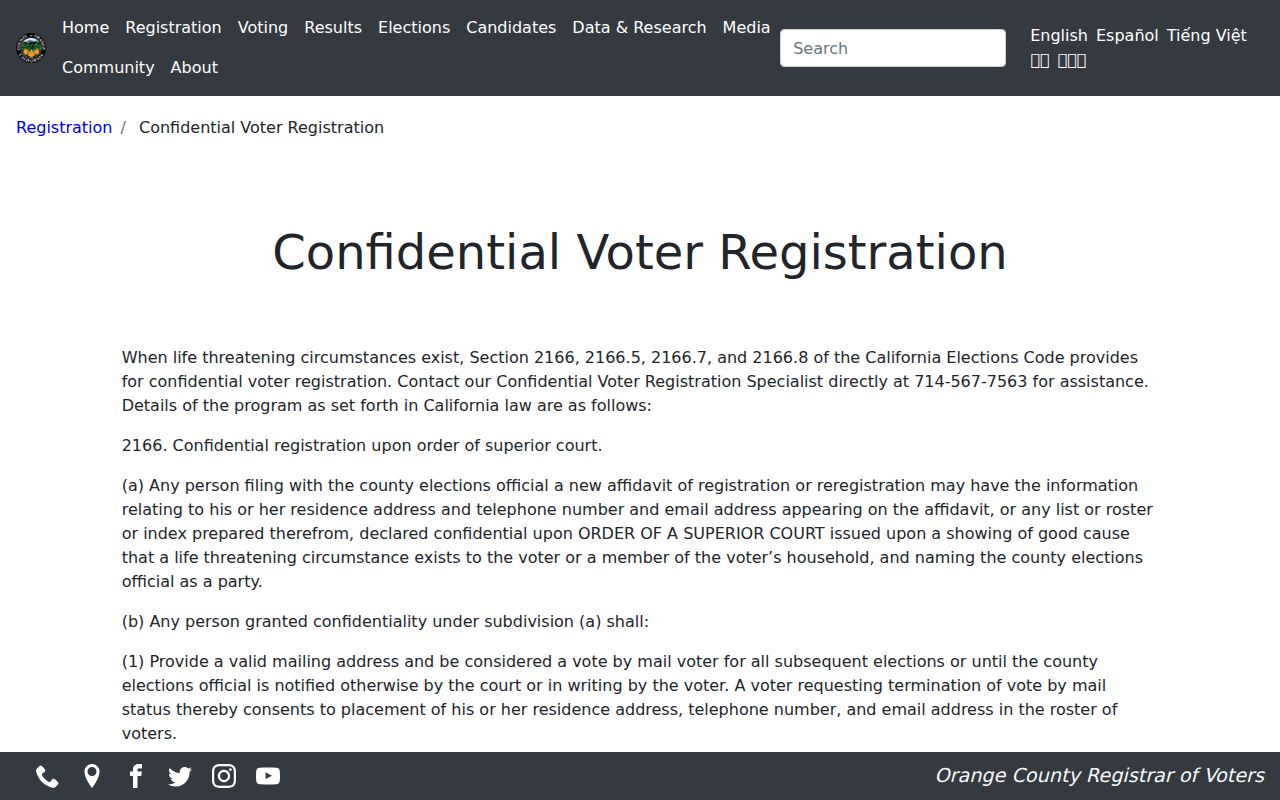
The county resource connects voters facing life-threatening circumstances with the proper specialist rather than exposing an address through the normal voter record process.
Orange County Address Protection
California's Safe at Home program adds an address-confidentiality path for people in covered safety situations. State, county, and city agencies accept a substitute mailing address in place of a residence or other mailing address. That protection can keep the home address out of voter records supplied to authorized file recipients.
The program covers specified survivors and people at risk, including victims of domestic violence, sexual assault, stalking, human trafficking, child abduction, and elder or dependent adult abuse. It also covers other statutory categories described by the state. Safe at Home can be reached at 877-322-5227 or SafeAtHome@sos.ca.gov. This protection is separate from a routine preference not to appear in voter data.
Orange County Participation History
Voting history is easy to misread. The optional history file can identify an election type and date and show the voting method. It can record that a voter took part, but it never reveals selections made on the ballot. Ballot secrecy remains distinct from the administrative voter roll.
Active records are supplied automatically in the standard state description, while inactive voter data must be requested. The source material does not give a county cancellation timeline, so no fixed lapse period should be assumed. A voter checking his or her own status should use the county lookup. A qualified researcher seeking inactive records must state that need on the data request.
Note: Participation history can confirm that a ballot process occurred, but it cannot establish which candidates or measures a voter chose.
Orange County Voter Rolls Aren't Directories
A California voter file is a restricted government dataset, not a public white-pages list. That distinction controls the whole Orange County process. The self-service tool verifies the voter who supplies private matching details. The file application serves only defined purposes and requires security safeguards. Neither route permits an open search of other residents for personal curiosity.
Elections Code section 2194 bars harassment, advertising, solicitation, sale, marketing, and unauthorized internet or display reproduction. Elections Code section 18109 provides a misdemeanor rule for voter registration information misuse. Recipients must keep the file within the purpose approved on the application and must not pass it into an unrelated use. General open-record procedures are explained separately in Orange County public records access, but those procedures do not override the voter-specific limits.
Historic Orange County Voter Records
Older election research follows a different trail. The Orange County Archives and local libraries are the likely custodians for historic registration registers, precinct books, campaign records, and local election material. Exact poll-book coverage years were not established in the official sources, so researchers should ask about a specific city, precinct, election, and date before arranging a visit.
Geography matters. Orange County was formed from Los Angeles County in 1889, so an earlier voter or civic record may sit with Los Angeles County or a state repository. Santa Ana is the modern county seat and the main civic center for the Registrar. Historic searches work best when a name is paired with the place and time in which the voter lived, since precinct lines and local jurisdictions change.