
Orange County Public Records Map
Access to public records depends on the record, not just whether an agency calls it public. Orange County deeds have a free online index, but the image comes from the Clerk-Recorder. Civil case summaries have date-based online coverage, while an official certified court record follows a copy process. Assessment, tax, and parcel-map tools divide property facts among three county systems. Birth, death, and marriage certificates are available as authorized or informational copies under different rules. The voter file is restricted by California law and is not a routine public name list.
| Record Set | Custodian | Web Coverage | Access Route |
|---|---|---|---|
| Recorded property documents | Orange County Clerk-Recorder | RecorderWorks index, 1982 to present | Free index; copies by mail or counter |
| Civil court cases | Orange County Superior Court | Unlimited/complex from 1996; limited from 2005 | Summary online; paid images and official-copy request |
| Assessment, tax, and parcels | Assessor, Treasurer-Tax Collector, county GIS | Current systems | Online tools plus assessor counter |
| Birth, death, and marriage | Clerk-Recorder or CDPH | No official county name index located | Application, identity check, and eligibility rules |
| Voter registration | Registrar of Voters or Secretary of State | Personal status tool; restricted data files | Qualified-use application only |
| Jail and offender information | OC Sheriff, CDCR, or California DOJ | Current public portions | Account or statutory-use limits may apply |
Sealed and juvenile court files, confidential family records, protected voter data, certain vital copies, and motor-vehicle data do not become open merely because another record names the same person. The custodian applies the governing exemption. An index is also not the record itself. That distinction shapes nearly every Orange County request.
Orange County Recorder Index Rules
RecorderWorks is the county's main grantor-grantee index. A grantor transfers an interest; a grantee receives one. The site covers recorded property documents from 1982 forward and searches names, instrument numbers, dates, document types, assessor parcel numbers, and legal descriptions. Broad last-name queries can time out, so adding part of a first name is a useful local tactic. After opening a document number, selecting an indexed name in the left menu groups other documents tied to that name by type and recording date.
| Search Mode | Input | Orange County Format Note |
|---|---|---|
| Name | Last name required | Add a partial first name to narrow a long search |
| Document number | From number; optional range | YYYY-NNNNNN |
| Book and page | Reference fields | Useful for older instruments |
| Recording date | Start and end dates | MM/DD/YYYY |
| APN or legal description | Parcel or land description | Connects the index to property systems |
These Orange County public records results are indexes, not scanned images. Before ordering, read the official recorded-copy instructions.
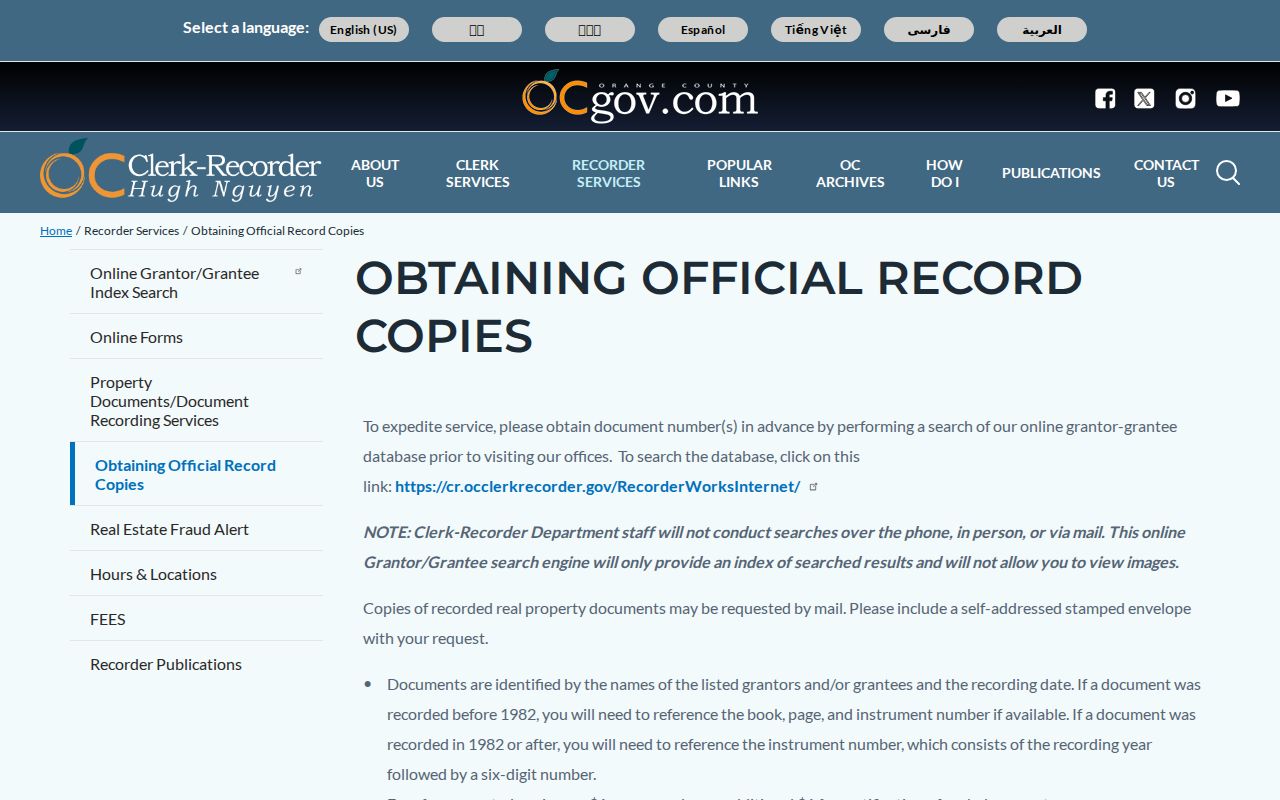
The instructions confirm that requesters must identify the document first. Copies cost $1 per page, and certification costs $1 per document or map. For pre-1982 material, use a book, page, and instrument reference when available, then turn to the counter or Orange County Archives if the online trail ends.
Orange County Court Record Channels
The Superior Court divides case access by civil, criminal and traffic, family, probate, and small claims. Its Case Name Search requires sign-in, though enrollment is free, and a party-name query may carry a charge. Civil Case Information has the clearest published reach: unlimited and complex civil cases from 1996, limited civil cases from 2005, and many documents filed from January 1, 2008 onward available to view or download for a fee.
Online summaries are not certified public records files. For an official civil copy, use form L-3009 or request it through the justice center that holds the case. Court copy guidance lists $0.50 per page plus added certification fees. Older indexes remain at the respective Justice Centers, and the civil records page says searches may reach from 1889 to the present. Exact party and filing details help the clerk locate the right file.
- Index
- A finding tool that points to a record but may not show the document.
- Certified copy
- A copy authenticated by the custodian as an official reproduction.
- Custodian
- The agency or office responsible for keeping and disclosing a record.
- Exemption
- A legal ground that permits or requires withholding all or part of a record.
Orange County Property Record Layers
No single Orange County portal supplies every property fact. RecorderWorks identifies recorded transactions. The Assessor supplies assessment information, parcel maps, and property characteristics online or at its public counter. OC Land Insights adds parcel geography, tracts, survey material, and map layers. The Treasurer-Tax Collector handles tax bills and payment status. Together, an APN, or assessor parcel number, acts as the common property identifier.
The Orange County tax bill application accepts a parcel number, street address, tax lien number, or watercraft or aircraft registration number.
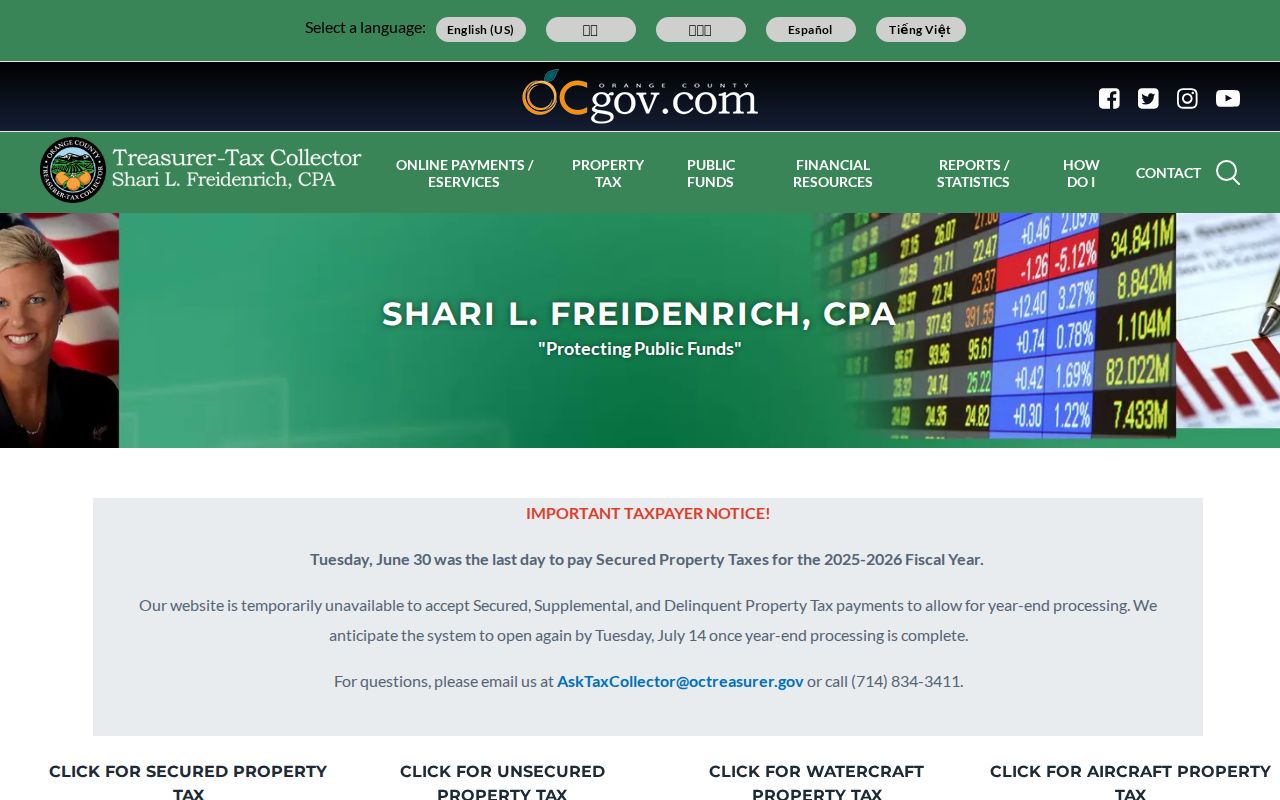
The image shows the separate tax-search surface. ParcelQuest Lite, linked by the Assessor, allows up to 50 searches and 25 parcel maps per month at the free tier; some reports or images may cost extra. For facts that the web view does not expose, the Assessor's Public Service Counter is at 500 S. Main Street, second floor, Orange.
Note: A situs address identifies the parcel location; a mailing address, when a record displays one, may point somewhere else.
Orange County Vital Record Access
The Clerk-Recorder issues Orange County birth, death, and marriage certificates, but it does not keep divorce records. Divorce case files belong with the Superior Court, while CDPH supplies certain statewide certificates. Eligible requesters may obtain authorized certified copies. Others may request informational certified copies for many records, stamped to show that they cannot establish identity. Confidential marriage records have no informational-copy option and may be ordered only by a party to the marriage.
Start with the Orange County vital records instructions before choosing the counter or mail route.
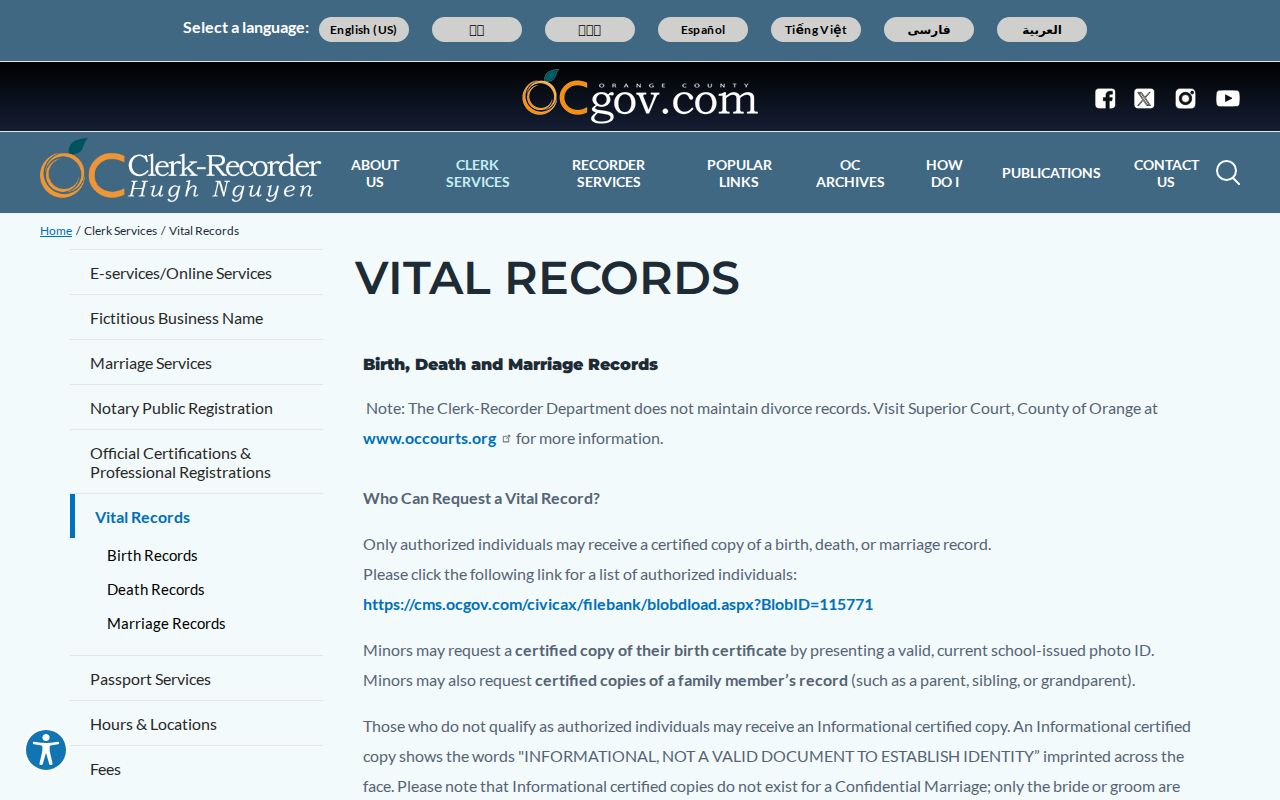
In person, complete the application first and bring valid photo identification; certificates are generally issued the same day. Mail forms must be signed and notarized, and most orders are processed within five to ten business days after receipt. County fees listed in the research are $34 for birth, $26 for death, and $19 for marriage certificate searches or copies. A search fee still applies if no record is found.
Orange County Records Custodian Desks
Santa Ana is the county seat and the main civic-record center, but the right counter depends on the document. The Clerk-Recorder combines recorded documents, vital records, fictitious business names, and the Archives. The court clerk holds case files. Property assessment questions go to the Assessor rather than the Recorder. These cards identify the principal desks and their official access pages.
Orange County Clerk-Recorder
12 Civic Center Plaza, Santa Ana, CA
714-834-2500
Superior Court Clerk
700 Civic Center Drive W., Santa Ana, CA
657-622-6878
Orange County Assessor
500 S. Main Street, 2nd Floor, Orange, CA
714-834-2734
Branch choices also matter for certificates. Vital-record service is available at the Central Office on Ross Street in Santa Ana, the North County branch in Anaheim, and the South County branch in Laguna Hills. Check the office page before traveling because service type and hours can differ by branch.
Orange County Record Custody Boundaries
An Orange County mailing address does not prove that county government created the desired record. Incorporated cities such as Anaheim, Santa Ana, Irvine, Orange, and Fullerton keep their own council files, permits, code cases, and some police records. County departments hold records for county operations and many unincorporated areas. A city clerk request should therefore precede a county request when a city agency issued the permit, citation, or local decision.
The date can change the custodian too. Orange County formed from Los Angeles County in 1889, so earlier land and government trails may sit in Los Angeles County, state, or mission-era repositories. RecorderWorks begins in 1982. Court records predate the modern portal, and old indexes remain at justice centers. The Orange County Archives bridges many gaps through historic property documents, vital material, newspapers, directories, photos, and county government collections.
Orange County Custody Record Limits
The Orange County Sheriff's Inmate Information System is inside an authenticated Public Services Portal. First-time users create an account with an email address and password. The current system does not display inmate charges, so it should not be described as a full jail roster. State custody records belong in CDCR's CIRIS, while federal custody searches use the federal locator.
The Sheriff's inmate-system notice states the account and display limits.
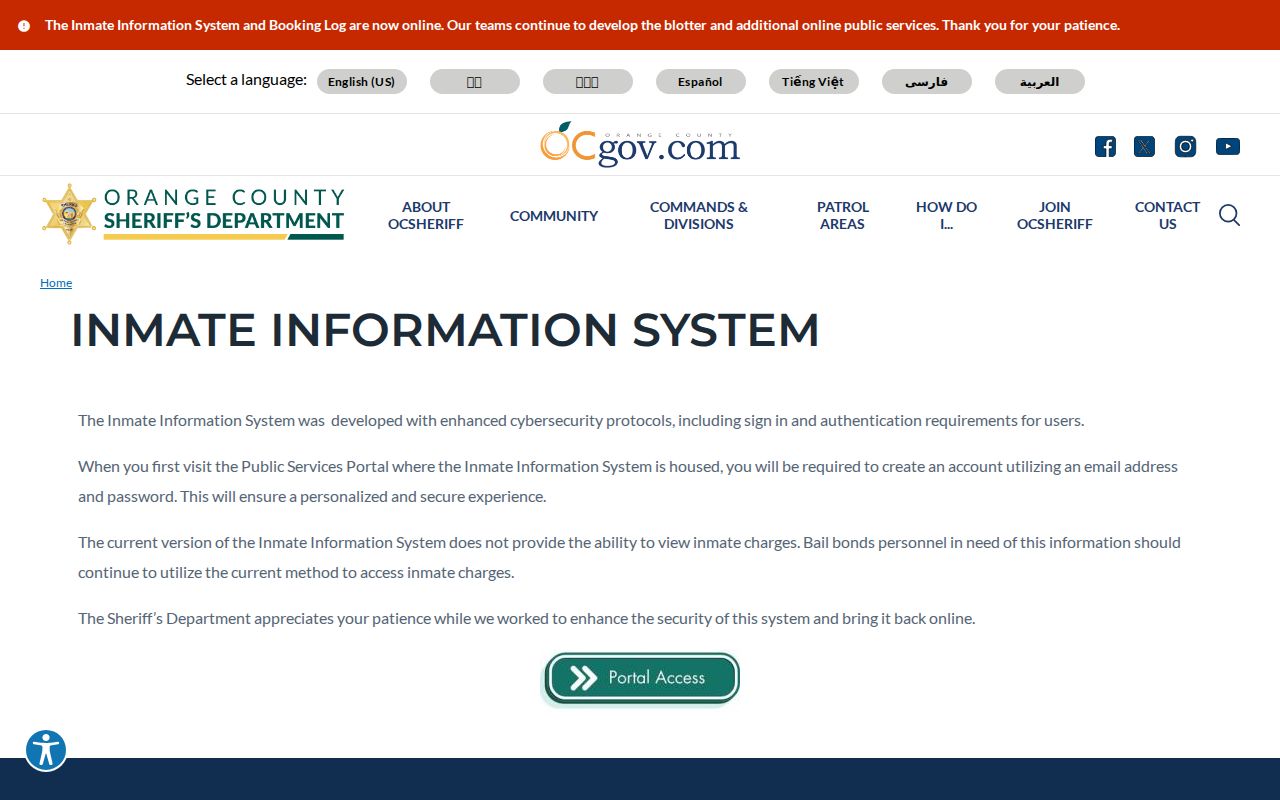
That notice helps set expectations before sign-in. California's offender registry is a different system, with disclosure and use limits fixed by state law. Read the Megan's Law search notice before entering the registry.
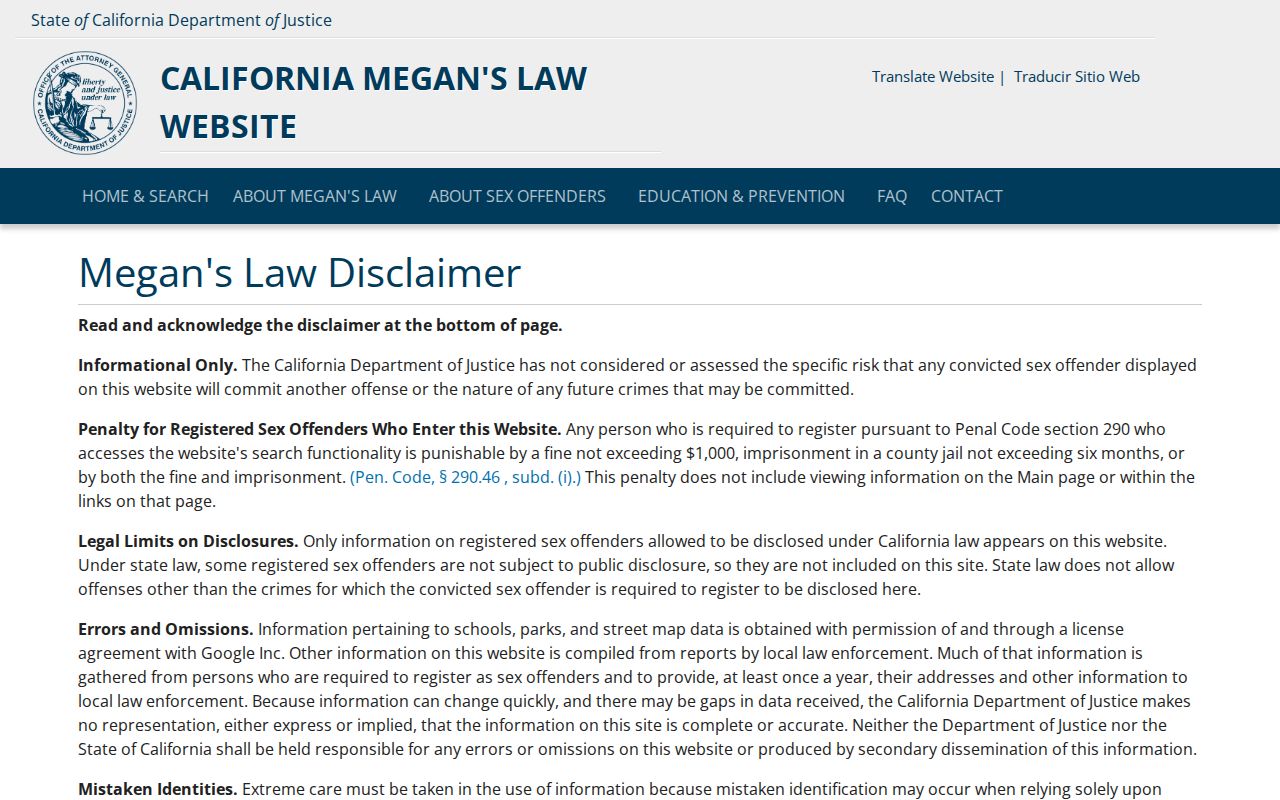
The registry image reinforces that not every registrant or offense is publicly displayed. Its information must be used only within the legal terms shown at entry.
Orange County Heir Record Trails
Probate, deed, and archive records can support lawful family-history and heir research. A probate docket may name interested parties, while a deed index can show a recorded transfer connected to an estate. Older telephone books, newspapers, and vital material help distinguish people with similar names. The Orange County Archives also preserves the federal court record of the county's 1994 bankruptcy, alongside local directories, photographs, government files, and the Knott's Berry Farm Collection.
Use each source for what it proves. An index entry proves that a document was recorded under an indexed name, not that two matching names identify the same person. A case caption does not reveal the whole disposition. Certified copies, dates, addresses, and related filings provide the context needed to reconcile a family line without guessing.
Orange County Records and Privacy
Public records rules coexist with specific privacy limits. California Safe at Home protects substitute-address participants. Voter signatures, identification numbers, and confidential-voter records are withheld. Sealed cases and protected family matters remain restricted. The county's fictitious business name system also changed on January 1, 2024: registrants no longer list a residential address and instead provide a business mailing address that cannot be a post office box or mail-service address.
State privacy tools address copies held outside government custody. The California DROP portal gives consumers a state channel for deletion requests to registered data brokers.
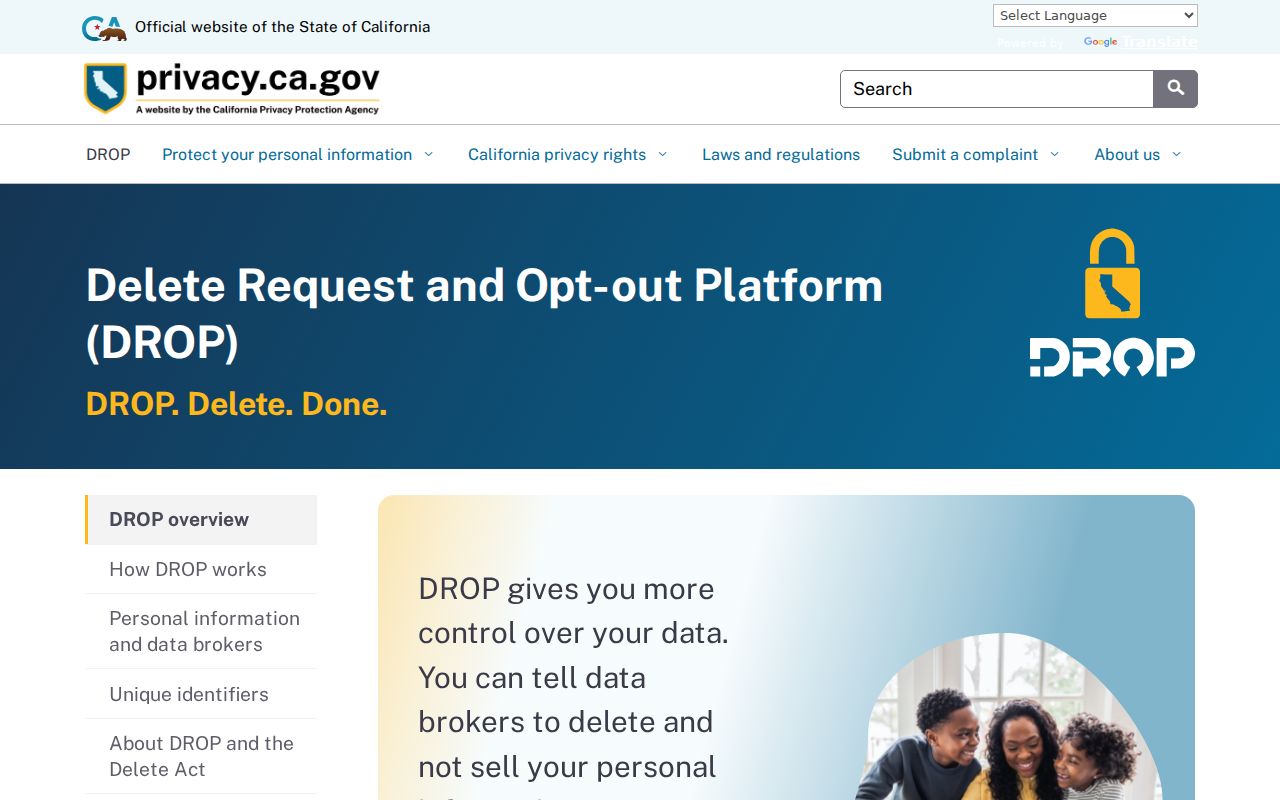
The portal does not erase the official source record or override a retention law. It addresses covered broker-held data, so requests for sealed or corrected government files still go to the agency that keeps them.
Lawful personal use. Use Orange County records for legitimate research and civic purposes. Never use record data to stalk, harass, threaten, or harm another person.
Request Orange County Public Records
The California Public Records Act covers agency records unless a statute or exemption closes them. Orange County says anyone may request inspection or copies and need not state a reason. Under Government Code section 7922.535, an agency normally has ten days to determine whether it holds disclosable records. Written notice may extend that determination by no more than fourteen extra days for unusual circumstances.
- Identify the custodian. Send county records to the relevant county department and city-created records to that city's clerk or department.
- Check the index first. Capture case numbers, document numbers, dates, names, APNs, and other identifiers that narrow the work.
- Describe existing records. Give a clear date range, subject, department, and record type through the Orange County request channel or the office's specific form.
- Choose inspection or copies. County electronic records are free; standard printed pages are $0.15 each, while media costs are charged at actual cost.
- Review the determination. If material is withheld, read the stated exemption and narrow the scope when that would reach segregable, non-exempt portions.
A general records-act request is not a substitute for a certified deed, court copy, or vital-record application. Those have their own forms, fees, identity rules, and certification steps. Matching the request to the right process avoids delay and preserves the status of the copy received.